
The possibility that industry could pay more for water is now part of a wider UK policy discussion. On 10 September, The Guardian reported that ministers had asked the Environment Agency to examine how water is valued and how the abstraction licensing system works. No price rise, new charging model or timetable has been announced.
For water-intensive sites, however, waiting for policy to crystallise may miss the bigger issue. Industrial water pricing is only one part of a wider shift in how water needs to be valued: as an operating cost, a constrained resource and a resilience issue.
Why the value of water is moving up the agenda
The Environment Agency’s National Framework for Water Resources says that, without continued action, England could face a public-water-supply deficit of up to around 5 billion litres per day by 2055. It also expects additional demand from sectors outside public water supply, particularly energy, food and data centres.
The pricing question is not new. In evidence to the House of Lords Environment and Climate Change Committee in February 2026, Environment Agency Director of Water Helen Wakeham said abstraction charges are based on the regulatory service rather than the value of the water, and identified an opportunity to review charging to incentivise efficient use.
That does not mean every industrial user should expect the same commercial impact. A site abstracting water directly operates under different arrangements from a business supplied through the public network. But the direction of travel is relevant to both: water availability, efficiency and resilience are becoming harder to separate from cost.
The business case is bigger than the water bill
For manufacturers and other water-intensive operations, the issue is not simply whether the unit price of water might rise. It is what water really costs across the site once supply, treatment, energy, chemicals, sewer or discharge charges, maintenance and production risk are considered together.
A change in water abstraction charges could alter the economics for some users. Yet even without a policy change, a site with limited supply headroom, high discharge costs or growth plans may already have a strong reason to improve industrial water efficiency and strengthen water resilience.
Understanding the water balance before choosing the treatment approach
The first step is to understand where potable water is genuinely required, where alternative water sources may be suitable, and which process streams could be recovered rather than sent to drain. That means mapping flow, quality, variability, current treatment and water costs before selecting equipment.
This is where industrial water recycling and reuse can become commercially relevant. Depending on the application, recovered water may be suitable for rinsing, cooling-tower make-up, boiler make-up or other duties after appropriate treatment.
Reuse is not automatically right for every stream. Feedwater chemistry, required water quality, compliance, energy use, space, maintenance and whole-life economics all matter. A pilot trial can help establish whether a proposed treatment route will work at full scale.
When water value changes, site economics can change quickly
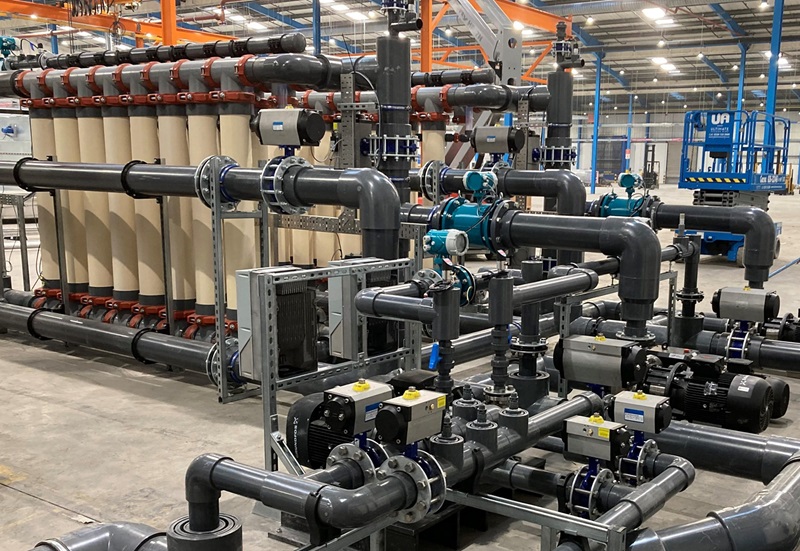
Envirogen has already seen how the economics can shift. For one industrial manufacturer, a direct nanofiltration system achieved 89% wastewater recovery and delivered more than £800,000 a year in water-bill savings, with payback in less than 18 months. The result is site-specific, but it shows why measuring water use and recoverable streams can expose opportunities that are easy to miss when water is treated as a low-cost utility.
Do not wait for a price signal to understand the risk
The more useful question for industrial operators is not whether water will definitely cost more next year. It is whether the site remains commercially and operationally robust if water becomes scarcer, more tightly managed or more expensive over time.
That can be assessed now. A clear water balance, realistic view of where potable quality is needed, and site-specific evaluation of recovery and reuse can show where action is technically practical and financially worthwhile before cost or supply pressure becomes an operational constraint.
Whatever happens to industrial water pricing, the current debate reinforces a wider point: the value of water is becoming harder to ignore. For water-intensive sites, that strengthens the case for understanding where water can be reduced, recovered or reused before cost or supply pressure forces the decision.
Envirogen can help industrial and data centre teams assess water use, identify recovery and reuse opportunities and evaluate industrial water treatment technologies against water quality, compliance, resilience and whole-life cost. Discuss your project.