
Groundwater provides around a third of England’s public water supply. As AMP8 delivery accelerates and AMP9 planning begins, treatment choices being made now will influence source resilience and operating performance for years. Sustainable groundwater treatment therefore has to do more than remove a contaminant. It must balance drinking-water quality, wastewater and residuals, energy and chemical demand, site constraints and whole-life operation.
Originally authored by Bill Denyer for Water Industry Journal. Expanded and adapted by Envirogen for deeper UK groundwater treatment insight.
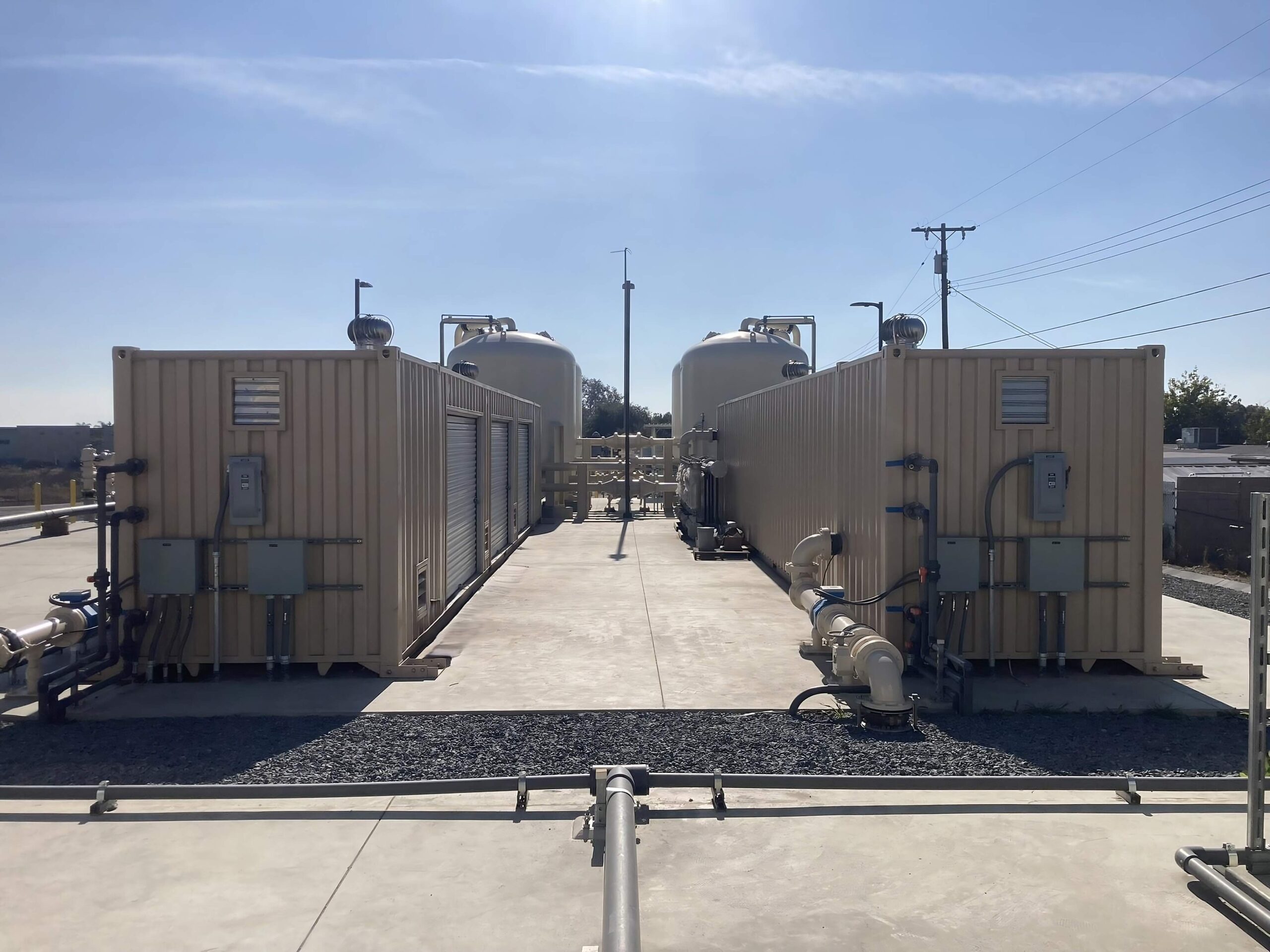
Groundwater can look like the reliable part of a water-resources portfolio: protected beneath the surface, relatively stable and capable of buffering short-term weather extremes. Yet the chemistry of an aquifer and the land above it can create water-quality challenges that persist for years or decades.
That distinction matters. Nitrate associated with diffuse agricultural pollution can persist in groundwater for long periods. Arsenic can occur naturally where water-rock interaction releases it from aquifer materials. Pesticides and other dissolved contaminants create different source-specific risks. In England and Wales, the Drinking Water Inspectorate (DWI) sets a nitrate standard of 50 mg/L and an arsenic standard of 10 micrograms per litre at consumers’ taps, alongside strict limits for pesticides and other parameters.
High compliance at the tap should not be mistaken for an absence of source-water risk. DWI reporting shows that vulnerable sources are actively managed through measures including catchment management, blending, treatment, operational monitoring and contingency planning. The engineering question is broader than whether a technology can remove a contaminant. It is whether the chosen treatment strategy can protect water quality and source viability with an acceptable whole-life burden.
What makes groundwater treatment sustainable?
Sustainable groundwater treatment means achieving the required water quality while minimising avoidable resource use, waste generation, operational burden and long-term impact on the source. It is not a single technology choice.
Source protection remains fundamental. Catchment interventions, abstraction management, blending and monitoring can all form part of the answer, and treatment should not be used as a substitute for managing the source itself. But where treatment is required, the process should be assessed against the conditions that will determine whether it remains practical over its operating life.
That source-level perspective is becoming more important as England puts greater emphasis on groundwater intelligence. The Environment Agency has now awarded its Groundwater Modelling National Framework 2026-2034, designed to support national modelling services and the sustainable management and protection of groundwater resources. The EA’s National Framework for Water Resources 2025 describes groundwater as a valuable resource that provides natural storage and can strengthen supply resilience in appropriate locations, while also noting that 27% of groundwater bodies currently have unsustainable levels of abstraction and that hotter, drier summers may shorten groundwater recharge seasons.
Better modelling can help identify where groundwater is available, where abstraction is under pressure and where environmental or water-quality risks need closer attention. But identifying a viable groundwater resource is only part of the equation. Where abstraction itself can be undertaken sustainably but groundwater quality constrains potable use, appropriate treatment can help address that water-quality barrier. This is why the role of improved groundwater intelligence in supporting water resilience is relevant to the treatment discussion. Groundwater intelligence, source protection and treatment strategy should remain complementary rather than substitutes for one another.
Those conditions include raw-water chemistry and seasonal variability, contaminant loading, competing ions, flow, required treated-water quality, waste and discharge routes, access to sewer, footprint, energy and chemical demand, staffing, maintenance and resilience. Reverse osmosis, activated carbon, oxidation, coagulation and ion exchange can each have a legitimate role. In some cases, the right answer is a treatment train rather than a single process. The strongest decision starts with the water and the site, not with a preferred technology.
AMP8 and AMP9: Why groundwater treatment decisions are being made now
The timing makes that broader assessment especially important. Ofwat’s PR24 settlement supports a record £104 billion investment programme for 2025 to 2030. At the same time, the next planning cycle is already moving: pre-consultation for Water Resources Management Plan 2029 (WRMP29) is under way, with resource position statements due in 2027 and draft plans in 2028. Sustainability changes identified through PR29 will feed into AMP9, covering 2030 to 2035.
For groundwater treatment, this is not abstract long-range planning. Current DWI AMP8 improvement notices include borehole schemes where water companies are required to confirm the appropriateness of proposed ion exchange solutions for nitrate, then progress through outline design, construction and commissioning towards 2030. In other words, some treatment choices are being tested and shaped now.
The people influencing those choices extend well beyond the operating water company. Water-quality and asset teams work with consulting engineers, programme and capital-delivery partners, design-and-build teams, framework partners, Tier 1 and Tier 2 contractors, process specialists and technology suppliers. That is where an experienced treatment specialist can add value early: helping translate source-water evidence into a practical design basis, validate treatment options and integrate process requirements with the wider scheme. Envirogen can support that journey from early assessment and pilot planning through engineering and project delivery. The earlier treatment constraints are understood, the more opportunity there is to design them into the scheme rather than resolve them late in procurement or construction.
SHAPING AN AMP8 OR AMP9 GROUNDWATER TREATMENT SCHEME?
Envirogen can support early-stage source-water review, treatment option appraisal, pilot planning and waste-route assessment before the specification is fixed.
Why wastewater can determine whether groundwater treatment is viable
Treatment performance is only one part of sustainability. What leaves the process can be just as important as what enters it.
At a large treatment works with established waste-handling infrastructure, concentrate or regeneration waste may be manageable. At a remote borehole with little or no sewer access, the same waste may require tankering or specialist disposal, increasing cost, carbon and operational complexity. A treatment route that works technically can become difficult to justify once the full waste route and whole-life cost are considered.
This is why water recovery, regeneration efficiency, chemical use and the final disposal route should be considered at concept and option-selection stage. For some contaminants, sustainable design may also require treatment of the regeneration waste itself before final disposal. These are design inputs, not details to be solved after the core treatment process has been specified.
When regenerable ion exchange makes sense for groundwater treatment
Ion exchange technology (IX) uses selective resins to capture dissolved ions from water. In a regenerable system, resin capacity is restored through a controlled regeneration cycle rather than treating the resin as a single-pass consumable. That can make regenerable IX a strong option for certain groundwater duties where the target contaminant, competing ions and site conditions suit the process.
Nitrate is the clearest current UK municipal groundwater treatment application, but it is not the only groundwater contaminant that may be addressed through ion exchange. For nitrate removal from groundwater, source chemistry and competing ions are central to technology and resin selection. DWI guidance also identifies ion exchange among the potential removal routes for arsenic, for example, while resin selection and system configuration can be tailored for other dissolved ionic contaminants. This flexibility is useful, but it reinforces the need for water analysis and application-specific validation. One resin or configuration should never be assumed to suit every groundwater source.
In suitable nitrate-removal configurations, SimPACK can achieve a wastewater ratio of down to 0.2%, representing up to 80% less wastewater than a representative conventional ion exchange design. Actual performance varies with source-water chemistry, system configuration and operating conditions.
For remote or space-constrained borehole sites, lower regeneration waste can reduce the practical and commercial burden of off-site disposal. Envirogen’s SimPACK and MinX platforms apply this regenerable, contaminant-specific treatment philosophy across different flow requirements, with automated regeneration and remote monitoring options. Detailed product specifications belong in the connected technology pages; the important principle here is to match the process to the source, contaminant and operating environment.
International application: US regenerable IX experience
The UK market is only one part of Envirogen’s regenerable ion exchange experience. In the US, Envirogen has more than 20 years of experience with regenerable IX for groundwater and drinking-water treatment. Publicly referenced nitrate projects include the City of San Fernando, City of Modesto and Monte Vista Water District in California.
California also provides a useful example of how the waste route can become part of the treatment design. Hexavalent chromium (Cr(VI)) is a specific US drinking-water treatment driver rather than a current UK groundwater treatment issue. Envirogen has used SimPACK for Cr(VI)-impacted groundwater in California since 2015. For suitable Cr(VI) and other metals applications, an optional Brine Processing Unit (BPU) can further condition the regeneration brine by reducing Cr(VI) to Cr(III) and precipitating the chromium, helping to reduce the potentially hazardous nature and volume of the residual waste.
The UK relevance is the engineering principle, not the contaminant itself: sustainable treatment should consider the entire contaminant pathway, from source-water chemistry and treatment performance through regeneration and final residuals management.
SimPACK technology overview video
Validation studies: Prove the groundwater design basis before you specify
Groundwater treatment design can be undermined by assumptions about source water that do not hold over time. A laboratory analysis taken at one point in time may not capture seasonal changes, competing ions or the operating conditions that will influence resin loading, regeneration frequency and treated-water performance. That is why validation studies, including repeat water analysis, bench testing or pilot trials, can be valuable where the chemistry or treatment route needs to be proven before full-scale specification.
For project teams, validation studies should answer practical questions as well as prove contaminant removal: What is the realistic design loading? What happens as raw-water quality changes? How will regeneration waste be handled? What space and utilities are available? How much operational intervention is acceptable? What redundancy and monitoring are required? How will the system integrate with upstream and downstream treatment?
These questions are relevant to water companies, consultants and delivery partners because they form the design basis that ultimately reaches procurement. Early specialist engagement is not about fixing a product into the specification. It is about making sure the specification reflects the actual water, site constraints and whole-life operating requirement.
For major capital programmes, technical fit also has to be matched by project-delivery capability. Envirogen has experience operating in complex, multi-stakeholder environments, including the HS2 programme, working alongside major contractor and consultancy groups. Its UK Project Management Office (PMO) supports multidisciplinary design control, programme and risk management, manufacturing and quality coordination, site integration, commissioning and handover.
That matters to water companies, Tier 1 and Tier 2 contractors and consulting engineers because the specialist treatment package has to interface with wider civil, mechanical, electrical, controls and programme requirements. A technically strong treatment design also has to be buildable, testable and commissioned reliably within the wider project. Once the plant is operating, it also needs to be monitored, serviced and maintained so changes in water quality, process performance or equipment condition can be identified early and managed before they affect compliance, availability or whole-life cost.
NEED TO VALIDATE THE DESIGN BASIS?
Discuss source-water assessment, validation studies, bench or pilot trials, waste strategy and project interfaces before full-scale specification.
UK Groundwater project spotlight: Regenerable IX in practice
Envirogen is applying this approach on a UK drinking-water groundwater project, working within a wider delivery team alongside a Tier 1 infrastructure contractor.
Following technical evaluation and validation, a SimPACK regenerable ion exchange solution was selected to address a persistent groundwater contaminant as part of a permanent treatment strategy. The project demonstrates how contaminant-specific treatment can be developed around source-water chemistry, required water quality, integration with the wider scheme and long-term operational requirements.
To respect the commercial confidentiality and project sensitivities of the organisations involved, the client, site and delivery partner are intentionally not identified.
Groundwater treatment is a long-term asset decision
Groundwater resilience depends on more than treatment. Abstraction has to remain sustainable, catchments have to be protected and water quality has to be monitored over time. Better data can reveal changing trends and improve operational decisions, but it cannot compensate for a treatment process that was selected without considering the source, waste route or future operating context.
The most resilient approach is therefore layered: protect the source where possible, monitor and understand change, use blending or operational controls where appropriate, and apply treatment where it is needed. When treatment becomes part of the solution, evaluate it as a long-life asset rather than a contaminant-removal package in isolation.
That principle matters as AMP8 delivery and AMP9 planning overlap. The schemes being defined today will operate through changing raw-water conditions, tighter resilience expectations and multiple investment periods. Bringing water companies, consulting engineers, capital-delivery teams, Tier 1 and Tier 2 contractors and specialist treatment providers together early gives those projects the best chance of balancing compliance, sustainability, buildability, programme certainty and whole-life performance.
Further reading/Source
- Drinking Water Inspectorate – Nitrate
- Drinking Water Inspectorate – Drinking Water Standards and Regulations
- Ofwat – PR24 / AMP8 context
- Environment Agency / GOV.UK – National Framework for Water Resources 2025
- GOV.UK – Water Resources Planning Guideline
- Water Industry Journal – original Sustainable Groundwater Treatment article
PLANNING OR REVIEWING A GROUNDWATER TREATMENT PROJECT?
Envirogen can support source-water assessment, pilot validation, treatment selection and engineered delivery.