
Integrated point-of-entry and point-of-use filtration supporting NHS estates teams in implementing NETB 2024/3
Estates teams are increasingly considering NHS POE POU filtration as part of a risk-based approach to managing waterborne pathogens such as nontuberculous mycobacteria (NTM) within healthcare water systems, particularly where high-risk patient groups are present. NHS Estates Technical Bulletin NETB 2024/3 highlights the need for proportionate, maintainable controls where local risk assessment identifies increased risk.
The Envirogen MediShield range provides an integrated approach to point-of-entry filtration NHS and point-of-use filtration NHS, combining system-level protection with targeted outlet filtration at critical locations.
Designed specifically for NHS estates water filtration requirements, MediShield supports Water Safety Groups in selecting, implementing, and maintaining filtration controls within established HTM 04-01 governance arrangements.
MediShield is designed specifically for NHS hospitals and UK healthcare water systems and is not intended for domestic or general commercial water filtration applications. NETB 2024/3 is advisory guidance; selection and implementation of filtration controls remain the responsibility of each Trust through its Water Safety Group risk assessment process.

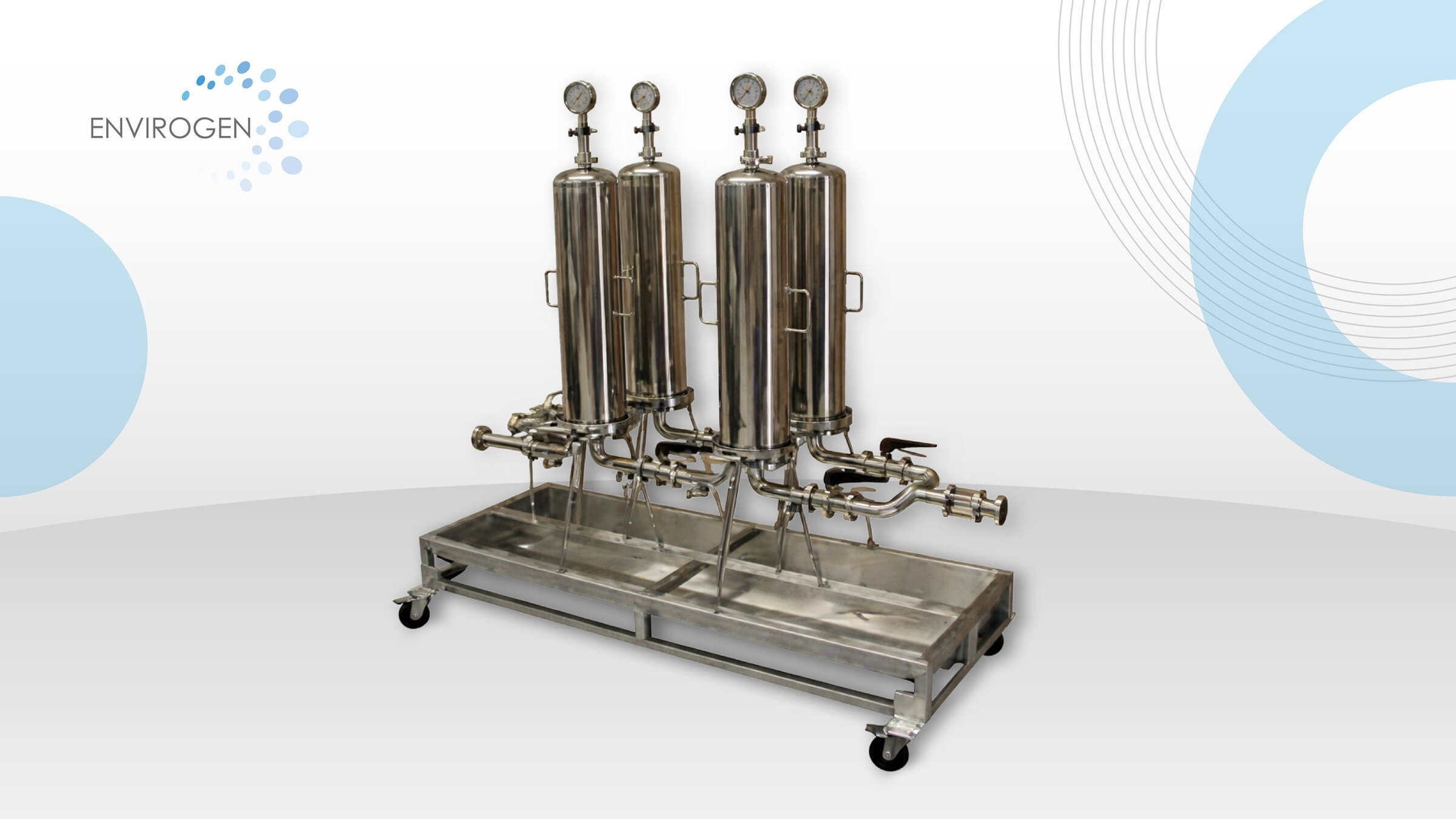
MediShield point-of-entry filtration NHS skid configured for acute hospital water systems.
Designed around NHS estates, facilities and water safety governance
MediShield has been engineered with direct reference to how NHS water systems are specified, operated, and assured. It supports:
- NHS estates and facilities teams responsible for day-to-day operation
- Water Safety Groups overseeing risk assessment and control selection
- Infection prevention and control teams providing clinical oversight
- Decontamination, endoscopy, and SSD services reliant on safe incoming water
This estates-led design reflects NHS governance structures, lifecycle accountability and audit requirements, providing a filtration option that can be documented within existing water safety plans.
A maintainable, multi-barrier filtration architecture for NHS water systems
Where filtration is selected as a control measure, MediShield provides a two-stage NHS POE POU filtration architecture designed to be maintainable, auditable and proportionate.
Filtration represents one of several possible engineering and operational controls and is applied alongside existing temperature management, flushing regimes, microbiological monitoring, system design and drainage measures where risk assessment indicates that additional protection is appropriate.
This structured, multi-barrier approach helps estates teams avoid ad-hoc or reactive filtration decisions, supporting clearer specification, easier maintenance planning, and more consistent assurance across the hospital estate.
Stage 1: Back-washable metallic pre-filtration (5 micron)
At point-of-entry filtration NHS locations, the first stage uses a stainless-steel, back-washable metal cartridge rated at 5 microns to remove suspended solids and protect downstream sterile filtration.
For estates teams, this delivers:
- A cleanable and inspectable upstream control
- Reduced reliance on disposable depth filters
- Lower whole-life costs and reduced consumable burden
- Mechanical robustness suitable for continuous POE duty in NHS water systems
Avoiding unmanaged disposable filtration
Disposable melt-blown depth filters cannot be back-washed or inspected and may present lifecycle and assurance challenges if not tightly controlled. MediShield intentionally avoids reliance on disposable depth filtration as the primary upstream stage, supporting NHS estates water filtration strategies that favour maintainable, auditable hardware.
Stage 2: Sterile-grade membrane filtration (0.2 micron)
The second stage provides a validated physical microbial barrier using pleated PES sterile-grade 0.2 micron membrane cartridges. These are suitable for controlling waterborne pathogens, including nontuberculous mycobacteria (NTM), where risk assessment identifies increased vulnerability.
Where filtration is selected as part of the overall control strategy, this stage provides a defensible microbial barrier at point-of-entry filtration NHS locations and can also be deployed within point-of-use filtration NHS devices serving higher-risk outlets.
Validation and materials compliance
Sterile-grade membrane cartridges deliver log reduction values (LRVs) greater than 7, validated using Brevundimonas diminuta in accordance with ASTM F838-20. This provides objective assurance of microbial retention performance where filtration is applied as a control measure.
Materials are suitable for use in potable healthcare water systems and comply with:
- 21 CFR 177
- EC 1935/2004
- USP Plastics Class VI (121 degrees Celsius)
Operating temperature and sanitisation capability
Sterile-grade PES membrane cartridges are designed to integrate with NHS hygiene and sanitisation regimes and are suitable for:
- Continuous operation up to 70 degrees Celsius
- Repeated hot-water sanitisation up to 90 degrees Celsius
- Steam sterilisation / autoclaving up to 134 degrees Celsius
This supports deployment within NHS water systems where elevated temperatures and periodic sterilisation form part of the wider water safety strategy.
Integrated NHS POE POU filtration under a single estates-led framework
Where many responses to NETB 2024/3 focus either on point-of-use filtration NHS devices or on a single point-of-entry filtration NHS installation in isolation, MediShield provides an integrated NHS POE POU filtration platform that can be configured across the hospital estate.
This estates-led framework allows filtration controls to be applied in a proportionate, risk-based way through the Water Safety Group, including:
- at system or block level through point-of-entry filtration NHS, and
- selectively at critical outlets through point-of-use filtration NHS
Deployment of POE and/or POU filtration is determined locally and may be applied independently or in combination, depending on system configuration, patient vulnerability, and risk profile.
MediShield filtration range overview
The MediShield range has been structured to support clear specification, scalability, and consistency across NHS estates water filtration projects, from community hospitals through to large acute and tertiary sites.
MediShield POU-18: Point-of-use filtration NHS
MediShield POU-18 provides targeted outlet protection where Water Safety Groups identify increased risk or vulnerability.
- Application: point-of-use filtration NHS
- Typical use: high-risk patient environments, specialist clinical areas, or temporary risk mitigation
- Flow range: 4-18 litres per minute
Typical deployment locations may include outlets serving higher-risk patient groups, isolation areas, or specific clinical environments where additional point-of-use protection is identified through local Water Safety Group risk assessment.
POU filtration can be deployed selectively to add a local microbial barrier without requiring system-wide intervention.
MediShield POE filtration systems: Point-of-entry filtration NHS
MediShield POE systems are engineered filtration skids designed to support consistent point-of-entry filtration NHS across hospital estates. This structure supports standardisation across multi-site Trusts while allowing sizing to reflect local demand. Typical configurations include:
MediShield POE-S (small hospitals and community sites)
- Indicative flow range: 36-108 cubic metres per hour
- Typical estate size: <100 beds
MediShield POE-M (medium acute hospitals)
- Indicative flow range: 145-290 cubic metres per hour
- Typical estate size: 200-400 beds
MediShield POE-L (large acute hospitals)
- Indicative flow range: 325-540 cubic metres per hour
- Typical estate size: 500-700 beds
MediShield POE-T (tertiary and teaching hospitals)
- Indicative flow range: 540-720 cubic metres per hour
- Typical estate size: 700+ beds
Monitoring, assurance and NHS estates service support
MediShield systems can incorporate differential pressure monitoring across filtration stages to support proactive maintenance and lifecycle assurance.
Where specified, system performance data can be routed to Envirogen’s NHS service team, enabling planned maintenance, consumable management, and responsive support through the PureCare service framework. This supports estates teams in managing NHS estates water filtration assets within a structured, auditable maintenance regime.
Part of a wider NHS water strategy
Envirogen delivers MediShield as part of a broader healthcare water systems strategy rather than as a standalone filtration product.
This wider capability includes:
- Healthcare reverse osmosis systems (EndoTherm)
- Large-scale laboratory water purification (LabPure)
- Water softening, ion exchange, and demineralisation
- Boiler and plant water treatment
Building on over 15 years’ experience delivering compliant healthcare water systems, including medical device reprocessing, Envirogen supports NHS estates teams across system design, installation, commissioning, and ongoing operation.
Why NHS estates teams choose Envirogen
- Experience delivering NHS water filtration systems into complex healthcare environments
- Integrated NHS POE POU filtration capability under a single estates-led framework
- Maintainable designs aligned with the principles of NETB 2024/3 and HTM 04-01
- Nationwide PureCare service capability supporting long-term system performance
Envirogen provides engineered filtration options and technical support; final decisions on selection and deployment remain with Trust estates teams and Water Safety Groups.
Frequently asked questions for NHS estates teams
Does NETB 2024/3 require POE or POU filtration?
No. NETB 2024/3 is advisory guidance. The selection of point-of-entry filtration NHS and/or point-of-use filtration NHS is determined locally by each Trust through its Water Safety Group risk assessment, alongside other engineering and operational controls.
Is filtration intended to replace other water safety controls?
No. Filtration is one possible control option and does not replace temperature management, flushing regimes, system design, drainage controls, or microbiological monitoring required under HTM 04-01 and local water safety plans.
Who is responsible for approving filtration controls?
Responsibility remains with the NHS Trust through its estate’s teams and Water Safety Groups. Suppliers such as Envirogen provide engineered options and technical input to support informed decision-making.
Speak to our team of experts to discuss POE and POU filtration options. Envirogen works with NHS estates teams to review water system risks, assess filtration requirements where appropriate, and identify maintainable solutions aligned with NETB 2024/3 and local Water Safety Group governance.